
Bringing Trust Closer to the Data For years, analytics teams built reports first and worried about consistency later. Every business unit calculated "revenue" its own way. Every dashboard told a slightly different story. Yet, the rules are being rewritten with the advent of the AI era. While Copilot can generate a chart or answer a question in seconds, the backend of that answer still depends on something structured, governed, and correct. According to Microsoft, the next generation of enterprise reporting requires a novel approach. That approach is the semantic model. Rebuilt as the AI-ready foundation of Power BI, the semantic model simplifies how organizations define, govern, and reuse business logic by bringing every report closer to one trusted definition of the data. More than just a technical layer, the semantic model represents Microsoft's vision for transforming Power BI from a reporting tool into a governed, AI-native analytics platform. A semantic model is the layer that sits between raw data and the reports people actually look at. Instead of forcing every report author to write their own version of "active customer" or "closed revenue," the semantic model defines these business terms once. Every report built on top of it inherits the same definition automatically.
This means people across the business get a single, shared source of truth instead of dozens of competing spreadsheets pretending to be dashboards. Why Did Microsoft Invest Further in Semantic Models? Microsoft rebuilt around the semantic model because companies need trustworthy reporting without sacrificing speed or flexibility. They have to do this while making sure AI tools like Copilot don't hallucinate numbers and while handling enterprise-scale data volumes. The old way, one dataset per report with duplicated logic everywhere, is too slow and too inconsistent to support real governance. Companies crave:
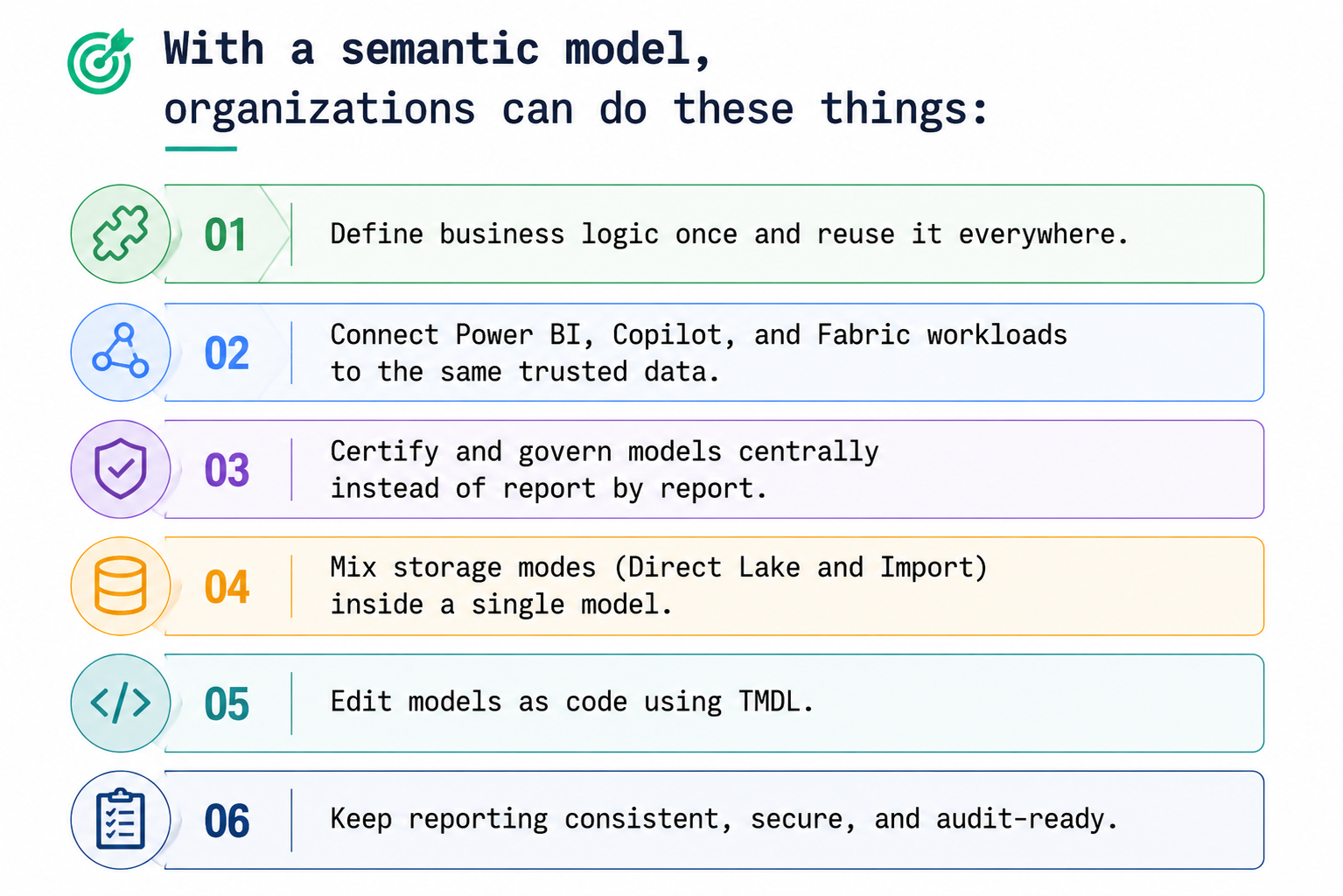
The semantic model tackles all of these issues by putting one governed definition of the business at the center of Power BI, Fabric, and Copilot alike. The goal is straightforward: move from raw data to a trusted answer faster, without giving up governance, compliance, or control. AI Changes the Rules of ReportingToday, building a report is fast: drag, drop, done. But making sure that report tells the truth is still hard. Duplicated logic, inconsistent metrics, and ungoverned datasets are what hold BI teams back. The 2026 semantic model updates were built to solve this. By centralizing business logic and connecting it directly to Copilot, Microsoft Fabric helps analysts and AI agents alike query the same trusted numbers. This means faster answers, stronger governance, and more time spent on decisions instead of metric reconciliation. Built for the Age of AI CopilotsThe semantic model is customized for a generation of analytics where AI assistants actively participate in exploring the data. Semantic models now let organizations:
In the AI era, people ask questions in plain language, Copilot interprets them, and the semantic model supplies the trusted answer underneath. Key Updates in 2026
1. Composite Semantic Models Composite models let teams mix Direct Lake tables (queried straight from a lakehouse or warehouse) with traditionally imported tables pulled in through Power Query connectors. Some of the advantages: ● Query billions of rows via Direct Lake without a slow import step ● Bring in small reference tables through any of Power Query's connectors ● Combine both inside a single governed model, invisible to the end user 2. TMDL on the Web Semantic models are no longer locked to Power BI Desktop. Developers define model structure through code (Tabular Model Definition Language) and edit it directly in the browser, inside the Power BI service. This makes semantic modeling particularly attractive for engineering teams adopting Git-based, CI/CD-driven workflows.
3. Copilot Grounding and Model Certification Copilot's answers are only as good as the model behind them. Teams can now: ● Certify and endorse models as the trusted source for Copilot ● Flag ungoverned or duplicated models before they mislead an AI-generated answer ● Treat "Approved for Copilot" as a real governance signal, not a badge 4. Governance by Design Semantic models now carry governance built into the object itself. Organizations can centrally manage: ● Certification and endorsement status ● Row-level security and access policies ● Refresh schedules and lifecycle ● Auditing of who queries what This is especially valuable for regulated industries like finance, healthcare, and government. Real Use Cases Across the EnterpriseEnterprise Governance: Large organizations consolidate dozens of duplicated models into one certified source of truth for revenue, headcount, or churn, so every team reports the same numbers. AI and Copilot Grounding: Analysts ask Copilot natural-language questions and get answers pulled directly from certified semantic models instead of ad hoc calculations. Performance at Scale: Retailers and manufacturers combine massive Direct Lake fact tables with small imported reference tables inside one model, without compromising speed or flexibility. Code-First Modeling: Data engineering teams manage semantic models like software, versioned in Git, reviewed through pull requests, deployed through CI/CD. Advantages Across the Organization 1. For business users: 2. For BI developers: 3. For data engineers: 4. For governance and IT teams: 5. For executives: Why Semantic Models Matter for the Future of Power BIThe semantic model is no longer just a technical layer sitting quietly behind a report. It represents Microsoft's strategic vision for the next generation of enterprise analytics. It combines: ● AI-grounded reporting ● Governed, centralized business logic ● Flexible, high-performance storage architecture ● Code-first, DevOps-ready modeling ● Native integration with Copilot and Microsoft Fabric Semantic models let organizations move faster without giving up control over what "the truth" actually means. Getting Ready to Modernize Your Semantic ModelsIf your organization wants to take advantage of these 2026 updates, here's where to start: ● Inventory the semantic models you already have. ● Identify and certify a canonical model for your top metrics. ● Evaluate composite models for large-scale or mixed-source data. ● Introduce TMDL and source control into your modeling workflow. ● Prepare your models for Copilot grounding, not just human report authors. Organizations that modernize their semantic models early will be in the best position to benefit as Power BI, Fabric, and Copilot continue to converge. Frequently Asked Questions1. Why should a business care about semantic models, not just IT?Because the semantic model decides what "revenue" or "active customer" means across the whole company. When it's governed well, every department, from finance to sales, works off the same numbers instead of arguing over whose report is right.2. Is a semantic model the same as a dataset?Yes. "Semantic model" is Microsoft's current name for what was previously called a Power BI dataset.3. Do semantic models support both Direct Lake and Import mode?Yes. Composite semantic models let you mix both storage modes inside a single model, which matters if your business has both large transactional data and smaller reference tables.4. How do semantic models affect Copilot's accuracy?Copilot queries the measures and definitions in the semantic model directly, so a clean, certified model produces more accurate, explainable answers. This is the main reason business leaders are starting to ask about semantic model quality, not just report design.5. Who actually owns and maintains a semantic model in an organization?Typically a BI or data team owns the model, but business stakeholders should be involved in defining what the key metrics mean. A semantic model built without business input often ends up technically correct but practically unusable.6. What's the business risk of not governing semantic models properly?Duplicated logic, inconsistent metrics across departments, and AI tools like Copilot surfacing conflicting or incorrect answers. Left ungoverned, semantic model sprawl quietly erodes trust in reporting across the company.7. How does this affect the cost of running Power BI at scale?Consolidating models reduces duplicated data storage, refresh cycles, and maintenance overhead. Fewer, better-governed models are typically cheaper to run and easier to audit than dozens of overlapping ones.
|
Power BI Semantic Models in 2026: Real Use Cases for What's New and Why It Matters


Share with your community!
BLOGS