
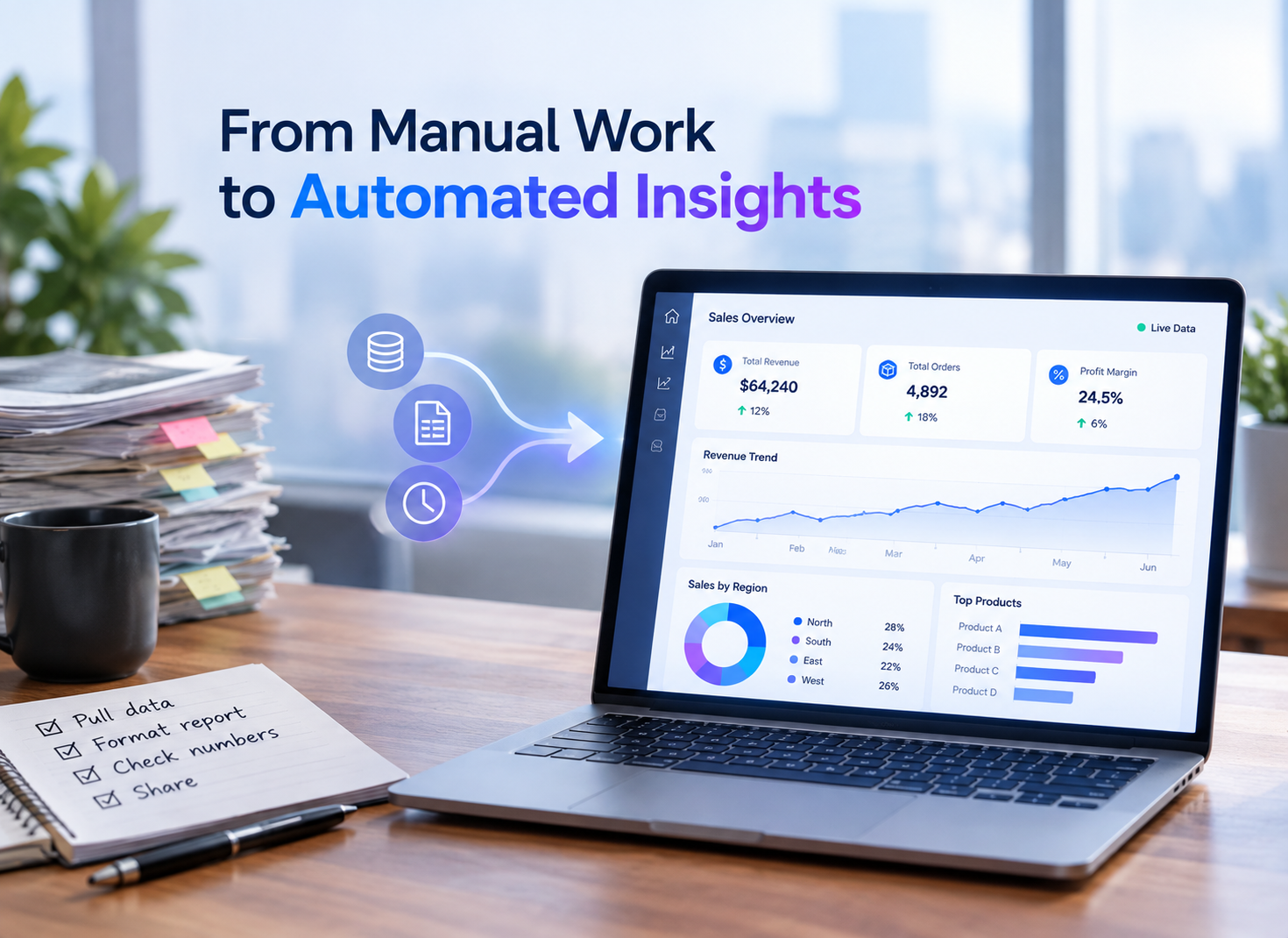
Manual reporting still eats up a lot of time in most organizations. Even the ones that are data-driven. Analysts spend hours every week pulling numbers from multiple disconnected systems, formatting spreadsheets, and double-checking figures before preparing a report to share. That time adds up quickly across an entire team, and it’s exactly the kind of repetitive work that rarely gets questioned until someone calculates its real cost. Switching to an automated dashboard can remove most of the manual effort. This replaces it with a live, consistently updated view of the data that matters most.
Why Manual Reporting Quietly Costs More Than It SeemsManual reporting is hardly expensive on paper. It’s mainly absorbed quietly into existing staff time instead of being tracked as a separate cost. Once you measure time across a team, the real cost becomes too hard to overlook. A couple of specific, easily overlooked costs go unnoticed for a long time inside an organization. It includes:
These hidden costs add up gradually. That is why several businesses are now exploring automated dashboard reporting tools as a long-term solution rather than a short-term convenience. Reaching that point often means turning to purpose-built automated dashboards instead of fixing the issue manually. A professional solution can address the root cause, not just the symptoms. Pinpointing where this cost is hidden is the first step. Typically, it starts with how reporting happens across the organization day to day. The Real Business Benefits of Automated ReportingAutomated reporting dashboards offer benefits that go far beyond saving time. It touches almost every area of how a business makes decisions and allocates resources. Let’s take a quick look at how the benefits break down across every area of business operations:
Pulling data manually from multiple systems is one of the most time-consuming areas of traditional reporting. Departments often repeat this process weekly or daily. Automated dashboards connect directly to source systems, eliminating this step from an analyst's workload. This typically eliminates:
Removing this single repetitive step entirely often frees up several hours per analyst. It’s done almost every week. This redirects that time to meaningful analysis instead of frequent data collection. Therefore, investing in dashboard reporting automation from the beginning adds up to savings as more data sources accumulate over time. Reducing Human Error in ReportingManual data handling introduces risks at almost every step. Risks range from simple typos to formula errors that quietly skew a report's conclusions. Automated dashboards can pull data directly from the source, removing the possibility of manual errors. Common errors this prevents include:
Fewer errors mean less time spent later tracking down misalignments and revising reports. This hidden cost rarely shows up until it’s already gone. Speeding Up Decision-MakingWeekly or monthly report cycles often delay decisions that could be made in real time by days or weeks. Automated dashboards give every decision-maker immediate access to existing data whenever they need it. Faster decisions typically result in:
Across competitive industries, this pace can translate into scalable competitive advantage over businesses that still rely on delayed, manual reporting cycles. Pairing prompt decision-making with stronger cloud data management solutions can keep the underlying data feeding those decisions secure and accurate. Reducing Reliance on Specialized StaffEarly reporting often relies heavily on specific analysts who know how to pull and format reports accurately. Automated dashboards standardize the process, reducing a business’s reliance on a single person’s manual knowledge. This reduced dependency helps with:
This helps businesses rely less on one or two individuals when reporting tasks are automated and documented. This ensures that businesses can operate seamlessly even if those people are unavailable. Freeing Up Skilled Staff for Higher-Value WorkSkilled analysts often spend hours each week on repetitive reporting tasks that create significant opportunity costs for growing businesses. Automating tasks frees up that expertise to focus on analysis, strategy, and other work that requires human judgment. This shift typically enables:
The Growing Shift Toward Automation
Source: Gartner, Automation Adoption Forecast Redirecting expert time toward other higher-value work is often where the real, long-term financial return of automation becomes clear to leadership. As these tools evolve, AI-driven data visualization and reporting can now differentiate businesses that are only automating from those that are truly transforming how they use data. Improving Data Consistency Across TeamsTeams often report similar metrics differently when they use separate spreadsheets or disconnected manual processes. Automated dashboards pull data from a single, shared source of truth, ensuring everyone works from aligned numbers. Consistency improvements typically include:
When teams work from the same numbers, they can move from debating data precision to discussing strategy and taking meaningful next steps. This alignment is one of the clearest early signs that broader digital transformation and process automation can help a business grow. Lowering the Cost of Scaling Reporting NeedsAs a business expands, its reporting volume and challenges also grow. This can become stressful with a poorly structured manual process. Automated dashboards often scale easily while handling additional data sources without a proportional increase in staff time. Scaling benefits typically include:
This kind of scalability often makes automated dashboards pay for themselves beyond the initial time savings. This is especially true when businesses continue to expand rapidly. For more practical ways to streamline business processes, read our blog on 5 Automation Wins You Can Deliver in 30 Days Using Microsoft Tools to discover how Microsoft tools can help reduce manual effort and improve operational efficiency. A Trusted Reporting Partner in Dream IT Consulting ServicesBuilding a truly effective automated dashboard takes more than software implementation. It requires the right data strategy, clean integrations, and a team that can translate raw data into something decision-makers can use. At Dream IT Consulting Services, we bring that combination to every reporting engagement. Clients generally opt to work with us to gain:
Contact us today to start building a reporting system that actually keeps pace with your business. Final ThoughtsAutomated reporting offers one of the clearest, most measurable returns in modern business technology, turning hours of manual work into minutes of real-time insight. As data volumes continue to grow, businesses that automate this process early tend to build a lasting operational advantage over those that keep delaying. Frequently Asked QuestionsHow long does it typically take to implement an automated dashboard fully?Implementation timelines vary considerably based on complexity, though many businesses see a fully functional dashboard within just a few weeks of starting the overall process. Do automated dashboards work with existing business software?Most modern dashboard tools integrate directly with common existing business systems, connecting to current data sources rather than requiring a complete, disruptive overhaul. Is automated reporting only useful for large enterprises?No, businesses of nearly any size can genuinely benefit, since even small teams often spend meaningful time on manual reporting that automation can eliminate.
|
How Automated Reporting Dashboards Save Businesses Time and Money



Share with your community!
BLOGS