
Bringing Applications Closer to the DataFor years, applications generated data while analytics platforms consumed it later through complex pipelines and integrations. Yet, the rules are being rewritten with the advent of the AI era. While AI can develop interfaces and business logic in a matter of minutes, the backend portion continues to involve databases, APIs, user authentication, security, and infrastructure management. According to Microsoft, the next generation of business development requires a novel approach. That approach is Rayfin. Built as an AI-first development experience for Microsoft Fabric, Rayfin simplifies how organizations build, deploy, govern, and operate intelligent applications by bringing them closer to where the data already lives. More than just a development tool, Rayfin represents Microsoft's vision for transforming Fabric from a unified analytics platform into an AI-native enterprise application platform. What Is Rayfin?Rayfin is Microsoft's AI-first, code-first backend development platform built natively into Microsoft Fabric. Instead of forcing developers to provision databases, configure APIs, manage authentication systems, build deployment pipelines, and maintain infrastructure manually, Rayfin allows teams to define application backends in code while Microsoft Fabric provisions and governs the underlying services automatically. Developers focus on the business logic and Fabric takes care of the platform. With Rayfin organizations can do these things:
This means that people get an experience that puts development, operations, governance and automation all together in one place. Why did Microsoft build Rayfin?Microsoft built Rayfin because companies need to make apps without sacrificing security or control. They have to do this while making sure everything is governed properly and can handle a lot of users. The old way of making apps is too slow. Has a lot of separate parts that do not work well together. This slows down ideas and the company still has to deal with high expectations. Companies crave:
Rayfin aims to tackle all of these issues by implementing an AI-native approach to the applications which minimizes the presence of backend infrastructure for developers. The goal is straightforward: Move from idea to production faster without giving up governance, compliance or control with Rayfin. AI Changes the Rules of Software DevelopmentToday, the process of making new applications has become quick and efficient, but the backend of the application is still a challenge. Databases, APIs, authentication, security, governance, and infrastructure are what's holding development teams up. Rayfin was built to solve this problem By using AI to develop and automate the backend setup, inside Microsoft Fabric, Rayfin helps developers and AI agents build, deploy and manage application backends with much less hassle. This means innovation happens faster governance is stronger. There's more time to create business value instead of managing infrastructure. Constructed for the Age of AI AgentsRayfin is customized for the new generation of software development in which AI agents actively participate in the application development process. Rayfin can:
During the AI era, developers state their purpose, AI assists them in constructing solutions, and Rayfin deals with the backend issues. Key Features of Rayfin:1. AI-Centered Development Practice In Rayfin, artificial intelligence is not an additional option. It serves as the core of the system. Developers can employ smart help to speed up their work, perform labor-intensive activities, and increase productivity. Some of the advantages are:
2. Code-First Development Model Rayfin is not a low-code platform. Instead, it embraces modern software engineering principles. Developers define application capabilities through code and configuration rather than manually managing infrastructure components. This makes Rayfin particularly attractive for professional engineering teams adopting AI-assisted development workflows. 3. Open SDK and Command-Line Tooling Rayfin includes an open SDK and command-line interface that integrates naturally into existing engineering processes. Teams can automate:
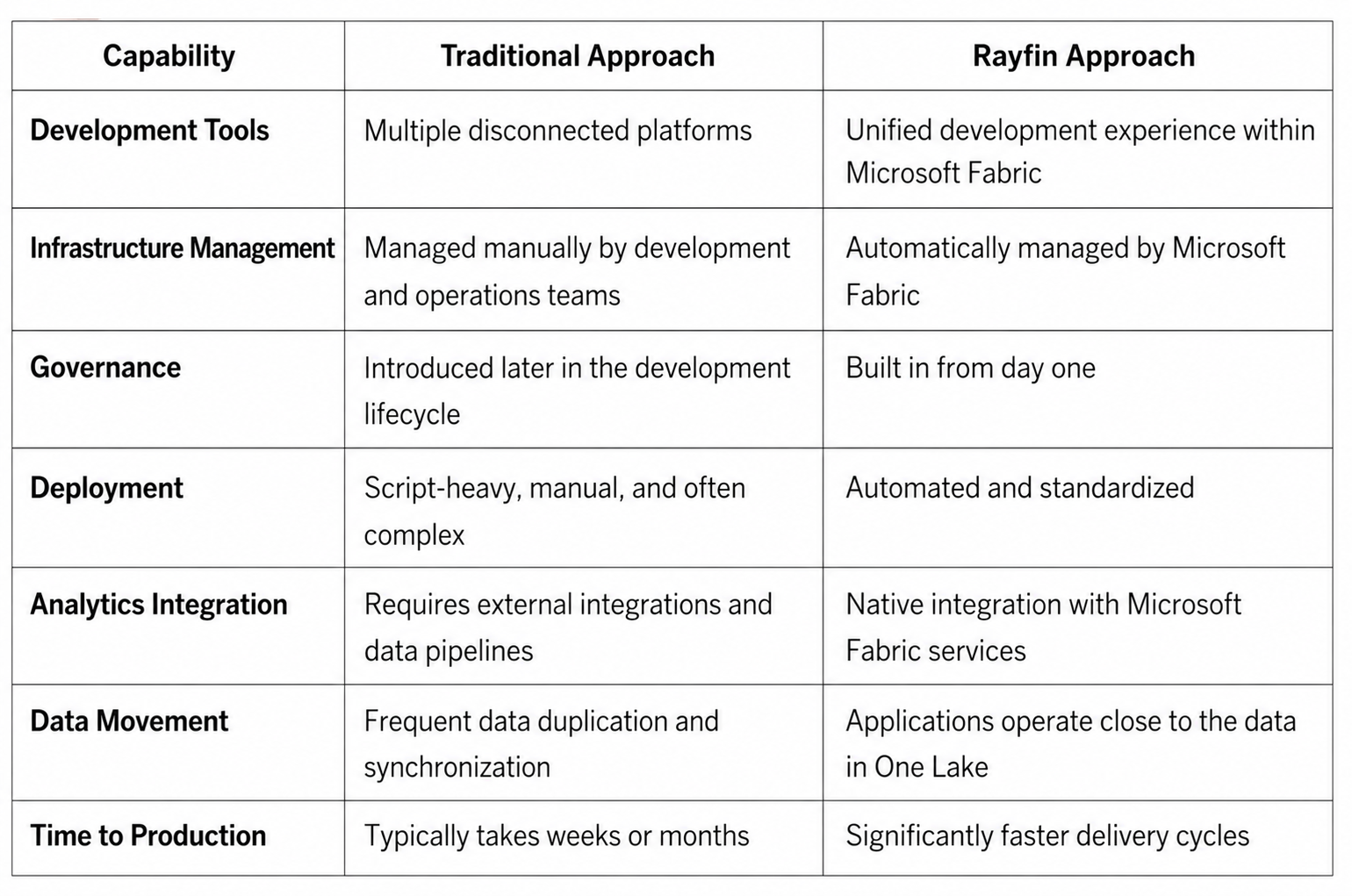
4. Deployment Made Easy Rayfin's most impressive attribute is the easy deployment. Developers design the backend and forget about everything else. Fabric takes care of the rest. The process of deploying databases, API's, networks, and hosting is significantly faster and more reliable. It will seem familiar to anyone who has worked with modern application development tools that hide the complexity from the developers. 5. Governance by Design Platforms have governance built right into them. Hence organizations can manage centrally:
This approach is super valuable for industries like healthcare, banking, insurance, telecommunications and government. In fact, Rayfin implements governance right from the start, instead of adding it post-deployment. 6. Rayfin's Native Integration with Microsoft Fabric Functions directly within the Microsoft Fabric platform This allows applications to take advantage of:
This provides an entirely seamless experience in the world of analytics. Understanding Fabric Apps and RayfinRayfin and Fabric Apps are closely connected components of Microsoft's broader vision. A simple way to understand the relationship is:
Together, they provide a fully managed backend platform for enterprise applications. Organizations gain access to capabilities such as:
Without managing these services independently. Why One Lake Integration Changes EverythingOne of Rayfin's biggest differentiators is its deep integration with One Lake, Microsoft's unified data lake for Fabric. The Traditional Challenge: In traditional architectures, operational applications and analytics platforms often live in separate environments. As a result, organizations need to maintain:
This increases complexity, cost, and operational overhead. How Rayfin Changes the ModelWith Rayfin, applications can run directly within the enterprise data estate, eliminating much of the data movement typically required between operational and analytical systems. Application data becomes instantly available for:
The Bigger PictureInstead of moving data to applications, Rayfin brings applications closer to the data. This shift has the potential to redefine how enterprises build data-driven applications and may become one of the most significant architectural innovations introduced by Microsoft Fabric.
|
Meet Rayfin: How Microsoft Is Transforming Data Application Development in Microsoft Fabric

Share with your community!
BLOGS