
What enterprise leaders need to know about Agent 365How many AI agents are running inside your organization right now? If you cannot answer that with confidence, you are not alone and that is exactly the problem Microsoft Agent 365 was built to solve. AI agents are no longer a future concept. They are already operating inside enterprise environments, reading documents, sending emails, making API calls, and completing multi-step tasks with minimal human involvement. The pace of AI Agent 365 implementation has accelerated rapidly, and with it, a challenge most organizations were not prepared for: how do you govern, secure, and scale AI agents you can barely see? Generally available since May 1, 2026, Microsoft Agent 365 represents one of the most significant changes to the Microsoft 365 ecosystem since the introduction of Copilot. For enterprise leaders driving enterprise AI transformation, understanding this platform is no longer optional but it is a strategic imperative. What Is Microsoft Agent 365?Microsoft Agent 365 is the Microsoft 365 AI control plane, a centralised system for managing agent identity, policies, observability, and lifecycle across your entire Microsoft 365 tenant. It is not a standalone AI tool. It sits above and around every agent in your environment, whether built with Copilot Studio, Microsoft Foundry, the Agent 365 SDK, or any open-source framework, and applies enterprise-grade governance, security, and compliance controls without requiring you to change your existing build stack. Agent 365's capabilities are powered by the four Microsoft pillars your security and compliance teams already know: Microsoft Entra, Microsoft Defender, Microsoft Purview, and Microsoft Intune. It extends their controls specifically to AI agents. The Real Reason Enterprises Are Quickly Adopting Agent 365 According to Gartner, a lot of enterprises will use AI agents by 2026. In fact, more than 80% of big companies will have AI agents in use. This is a jump from 2023, when less than 5% of companies used them. It is a change that will happen fast. If your organisation is still in evaluation mode, you are already behind the majority of your peers.Early adopters report that AI agents handling routine document processing, reporting cycles, and cross-system lookups save knowledge workers an average of 3–5 hours per week. Across a 500-person organisation, that is over 1,000 hours returned to strategic work every week, without adding headcount. But the bigger story is enterprise AI transformation. Agent 365 helps leadership teams put intelligence into tasks. This includes things like buying supplies, handling staff, managing money, helping customers, and following rules. When done well, it makes AI a part of how an enterprise works, not a tool to get things done faster. The Four Pillars of a Successful Agent 365 Implementation1. The Step Most Enterprises Skip The most common mistake is treating Agent 365 implementation as a software rollout rather than an organisational change. Before any AI Agent Deployment goes live, your organisation needs clear answers to: Who can deploy an agent? What data can it access? Who reviews agent actions and escalations? Microsoft offers a framework for governance through Purview and the Microsoft 365 Admin Center. Your organisation has to create the policies. This is where AI compliance consulting really helps. It translates rules from regulations like GDPR and ISO 27001 into permissions and audit trails for agents. At Dream IT, our enterprise AI practice has seen firsthand that organisations investing in governance architecture before deployment consistently outperform those that retrofit compliance after go-live. The ones that skip this step don't fail loudly, they stall quietly when legal or security flags a deployment that was never properly reviewed. 2. Choose the Right Scenarios First - Not the Most Exciting Ones Not all tasks are suitable for AI Agent Deployment right away. Focus on scenarios with structured data, clear success metrics, and a lower risk of errors. Some good starting points are:
Start narrow… Prove value… Then scale with credibility… 3. Your Data Estate Is the Foundation - Not an Afterthought Agent 365 is only as effective as the insights it can deliver. Before deployment, audit your Microsoft data estate: Is your SharePoint content tagged and structured? Are your Dynamics 365 records clean? Is Microsoft Fabric or Azure Synapse in place as your analytics backbone? Poorly organised data produces unreliable agent outputs. This is not a platform limitation but it is an organisational readiness issue that the best Agent 365 implementation projects resolve before the first agent is configured. 4. Change Management Is Where Most Implementations Win or Lose According to McKinsey, 70% of large-scale digital transformation programmes fall short and the leading cause is not technology. It is adoption. That failure rate is largely preventable. Bring department leads into the design process before deployment. Establish feedback channels for employees to flag unexpected agent behaviour. Make it clear that agents are there to reduce tedious work, not to monitor performance. That framing shift alone dramatically improves adoption rates. Is Your Organisation Ready for Agent 365?Before committing to a timeline, use the quick checklist below as an initial self-assessment, then complete Microsoft's official Agent 365 Readiness Assessment for a more comprehensive evaluation 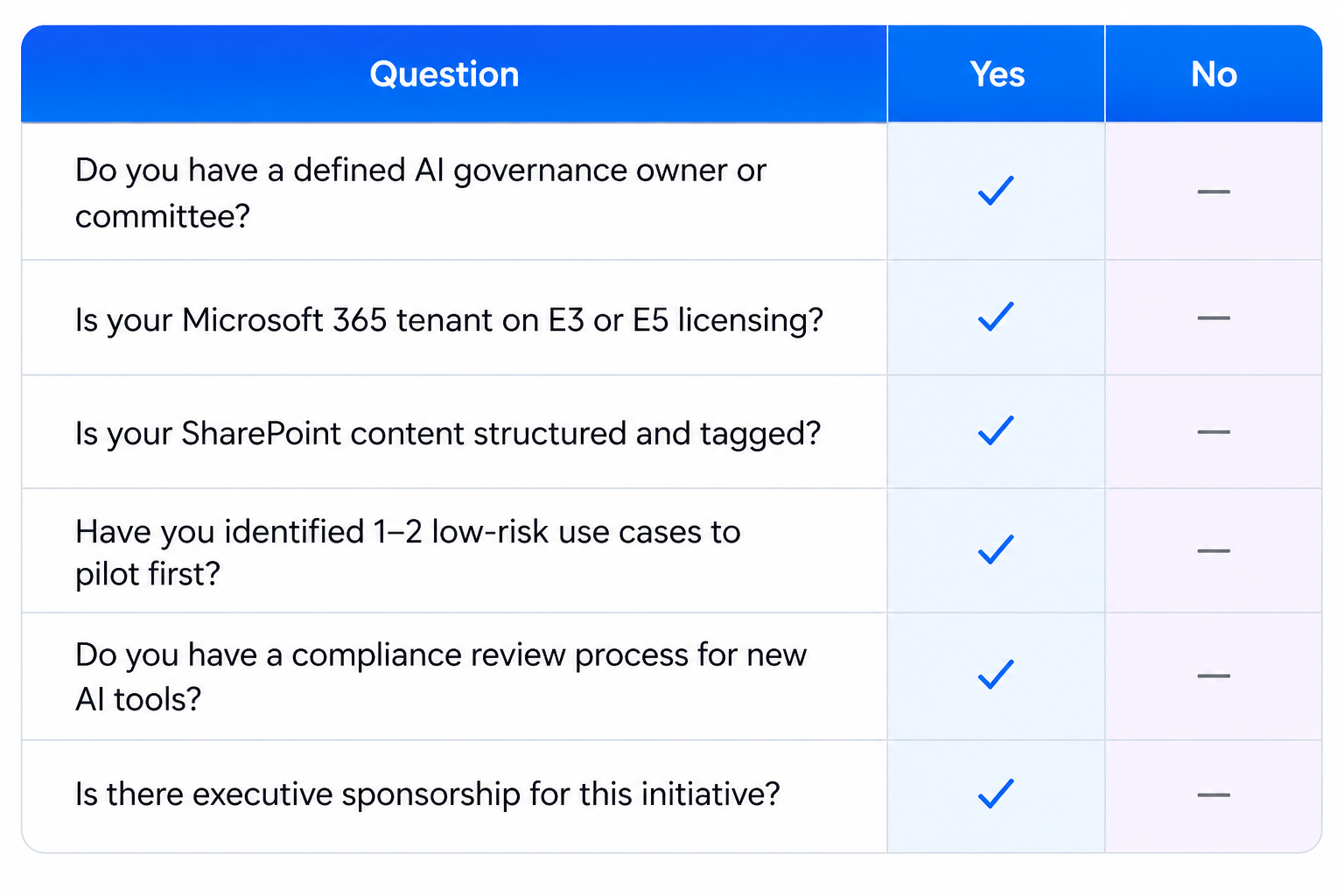 If you answered No to three or more of these questions, your implementation needs a foundation sprint before any agents go live. That is not a blocker - it is the realistic starting point most organisations share, and it is exactly what structured preparation is designed to address. If you answered No to three or more of these questions, your implementation needs a foundation sprint before any agents go live. That is not a blocker - it is the realistic starting point most organisations share, and it is exactly what structured preparation is designed to address.For a deeper evaluation, Microsoft provides an official readiness assessment tool to help organisations measure their Agent 365 preparedness across governance, data, and security dimensions. Access it here : https://learn.microsoft.com/en-us/assessments/94f1c697-9ba7-4d47-ad83-7c6bd94b1505/ A 6-Phase Agent 365 Rollout That Works in the Real WorldFollowing Microsoft's Cloud Adoption Framework for AI, a successful Agent 365 implementation spans six structured phases: Phase 1(AI Strategy): Identify AI use cases, define your AI technology and data strategy, and develop a responsible AI approach aligned to business objectives. Phase 2(AI Plan): Assess and acquire AI skills, prioritize use cases, access required AI resources, create proofs-of-concept, and establish responsible AI practices. Phase 3(AI Ready): Build your AI environment, establish AI governance and networking foundations, ensure reliability, and select the right architecture for your workloads. Phase 4(Govern AI): Assess organisational risks, document and enforce AI governance policies, and set up continuous monitoring of AI-related risks. Phase 5(Secure AI): Discover AI security risks, protect AI resources and data, and implement mechanisms to detect and respond to AI security threats. Phase 6(Manage AI): Oversee AI operations, deployments, models, costs, data, and business continuity to ensure sustained performance at scale. Each phase builds on the previous one and runs in coordination with the others. Organisations that move fastest treat Agent 365 as an evolving capability, not a one-time launch. Why AI Compliance Consulting Is Important
Dream IT brings deep Microsoft platform expertise and enterprise governance experience to every engagement, helping organisations move quickly without cutting corners. The EU AI Act: The Deadline Most Enterprises Are Underestimating There is a compliance dimension to Agent 365 that many enterprise leaders are not yet factoring in. The EU AI Act becomes fully applicable on 2 August 2026, introducing obligations around risk management, data governance, transparency, human oversight, and post-market monitoring — with fines reaching up to €15 (Euro) million or 3% of global turnover for high-risk violations. The opportunity is that many of the required controls are already present within Agent 365: your agent registry supports record-keeping requirements, Purview capabilities contribute to data governance and monitoring, and Entra identity controls underpin access management. But that mapping does not happen automatically — and without it, organisations risk duplicating effort or missing critical gaps. This is exactly where structured AI compliance consulting pays for itself. Getting that mapping right before the Act takes full effect is far less costly than addressing it after. (source: https://www.microsoft.com/en-in/microsoft-agent-365 , https://www.microsoft.com/en-us/trust-center/compliance/eu-ai-act )
|
Microsoft Agent 365 Implementation: A Practical Guide for Enterprise

Share with your community!
BLOGS